Why Counter-Strike 2 is Still the Perfect Video Game
We’ve all been there. You boot up a modern shooter, sprint across a massive map, slide-cancel around a corner, and get instantly obliterated by someone who bought a premium, pay-to-win weapon skin or activated a character-specific power that no one else has access to. It’s exhausting.
I’ve never been a fan of games that try too hard to be ultra-realistic, nor do I care for the ones bloated with “alts,” magic spells, and people riding freaking unicorns. But what I hate even more is when games introduce unique hero characters with individual superpowers, or worse, lock success behind a paywall. I don’t want to win a gunfight because my specific character has a cooldown ability that lets them teleport, or because I opened my wallet. I want to win because I played better.
And don’t get me started on the absolute circus that modern battle royale lobbies have become. Look, I love Star Wars as much as the next person, but playing as Din Djarin in a competitive shooter just isn’t my thing. And I definitely don’t want to be running around a map playing as Ariana Grande. I don’t want my competitive tactical shooter turned into a giant, immersion-breaking pop-culture mashup.
That’s why, after all these years, I keep coming back to Counter-Strike. With CS2, the game got a beautiful visual overhaul, but the core engine running under the hood remains entirely untouched. It is stripped down, brutally honest, and fundamentally fair. No pay-to-win garbage. No unique hero powers. No licensed pop stars running around the bombsites. Everyone starts the round with the exact same health pool, the exact same movement speed, and the exact same access to the weapon buy-menu.
But if you ask a casual observer why Counter-Strike is the perfect game, they’ll usually point to the insane highlight reels—the crisp mechanical aim, the pixel-perfect crosshair placement, or the legendary one-taps.
They aren’t entirely wrong. Raw physical execution is a massive deal. But focusing only on mechanics completely misses the soul of the game. For me, CS2 is the perfect game because it relies on a beautiful, unforgiving holy trinity of skill sets: Tactics, Communication, and Mechanics. When these three pillars interact, they turn a simple military shooter into a high-stakes psychological puzzle.
Here is a breakdown of how these three pillars hold up the perfect game.
1. Tactics
In CS2, you don’t have an ultimate ability that lets you see through walls, and you can’t build a temporary tower for cover. There is no magic to bail you out. Because everyone starts on an entirely even playing field, tactical depth is your primary weapon.
-
Map Control: You don’t just mindlessly sprint onto a bombsite. You use utility—smokes, molotovs, and flashes—to take control of critical choke points, cut off sniper sightlines, and flush enemies out of strong defensive positions. A single smoke grenade isn’t just a visual block; it’s a structural wall that completely changes the geometry of the map for 20 seconds.
-
Economy Management: Managing your team’s money over a 24-round match forces you to think three steps ahead. You have to coordinate your buy rounds, force buys, and saves based on your team’s financial standing. Doing a calculated “eco” round to save money for a full investment in the next round is a strategic art form.
-
Execution: You win by executing pre-planned strategies, running a “default” across the map to probe for weaknesses and gather information, or orchestrating incredibly fast rotations to retake a site under pressure.
When you win a round in CS2, it’s rarely just because you out-shot the opponent. It’s because you completely out-brained them.
2. Communication
You can have the mechanical aim of a god, but if you play CS2 with your microphone muted, you are actively throwing the game. Because the time-to-kill is so incredibly low—often a single bullet to the head—information is the absolute highest-value currency in the game.
This is where the game mirrors the core team dynamics we see in the real world. In professional team-building, experts often look at structural frameworks like the “Teamwork Architecture” pyramid mapped out by Event Solutions . As illustrated below
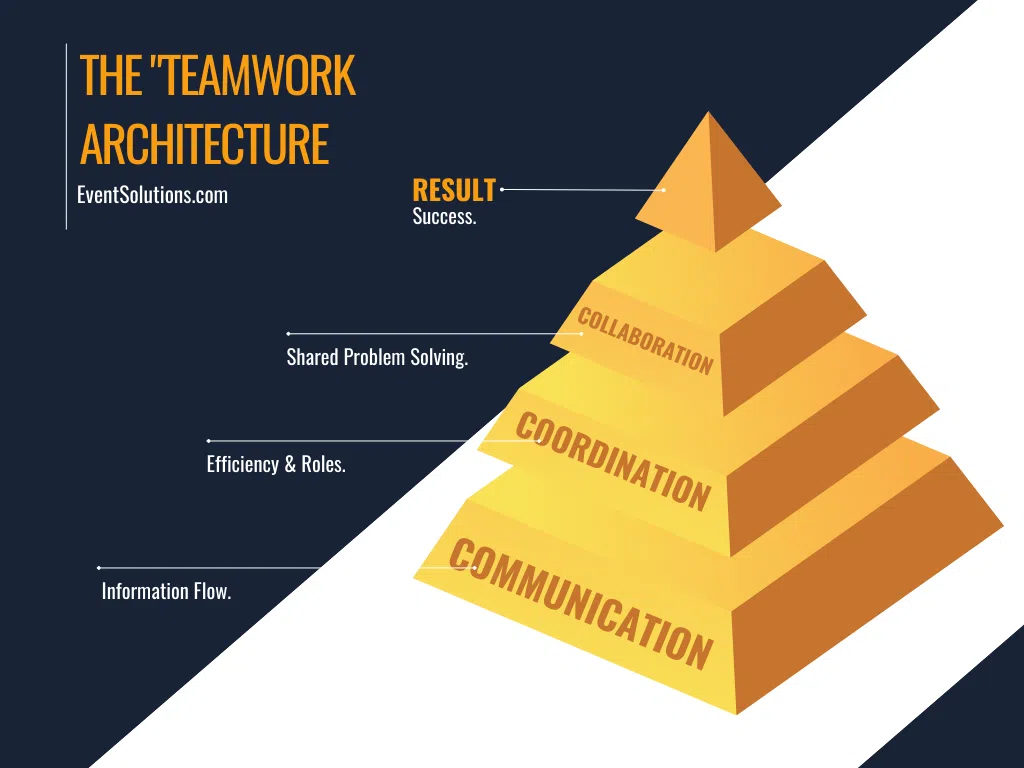
success is built on a foundation of information flow (Communication), roles/efficiency (Coordination), and shared problem-solving (Collaboration). CS2 demands this exact structure to function.
-
Concise Callouts: You have to relay exact enemy locations, damage dealt, and utility used without cluttering voice chat. In CS2, a clean callout sounds like a military operation: “Two pushing A Main, one’s tagged 84.”
-
Information Hierarchy: You must learn to pass crucial intelligence to teammates dynamically. Spotting the bomb carrier’s position or calling out the exact number of enemies pushing a lane changes your entire team’s defensive posture instantly.
-
Callouts and Rules: To do this effectively, teams rely on established, standardized map callouts. Every pixelated corner, box, and hallway has a universally agreed-upon name so that everyone understands rotations and threats at a glance.
A team of mediocre players who lift each other up, coordinate their economy, and communicate cleanly will almost always crush a team of five toxic aim-gods who are screaming at each other in voice chat.
Even better, by tightly executing all three of these pillars, you can routinely overcome and shut down a much higher-level “carry” player on the enemy team, even if you have a couple of sub-par players on your own side. CS2 is a team sport; cooperative execution beats raw, isolated talent every single day.
3. Mechanics
While tactics and communication lay the groundwork, you still have to execute. CS2’s mechanics are notoriously unforgiving, but mastering them is one of the most rewarding feelings in all of gaming.
-
Crosshair Placement: This is the baseline of high-level play. Instead of lazy aiming, you must constantly keep your crosshair exactly at head-level and pre-aim common defensive angles to minimize your physical reaction time when peeking.
-
Recoil Control: You can’t just hold down the left-click and hope for the best. Every weapon, particularly the AK-47 and M4, has a highly specific spray pattern. Mastering recoil control means physically counter-steering your mouse to secure accurate kills past the first few bullets.
-
Movement: Good mechanics are as much about your keyboard hand as your mouse hand. You must master counter-strafing (tapping the opposite movement key to instantly stop your momentum and make your shot accurate), peeking effectively, and clearing angles systematically without exposing yourself to multiple enemies at once.
4. The Skin Market: Purely Optional Expression
Now, you can’t talk about CS2 without talking about the massive Steam Community Market and the absolute behemoth that is the skin economy. But here is the critical distinction that people outside the community don’t get: it is totally, 100% optional.
A stock, gray AK-47 deals the exact same damage, has the exact same spray pattern, and reloads at the exact same speed as an ultra-rare, thousand-dollar skin. The skins don’t make the gun any better. There are no stat-boosts, no accuracy buffs, and no hidden advantages. It is purely aesthetics.
The market is just a fun, community-driven sandbox on the side. Sure, I personally love it—heck, I own 4 or 5 knives myself, and I’ve even made it my personal mission to own every single UMP-45 skin available in the game. And yeah, the knives are all Rust Coats, because the absolute best part is that I don’t have to care about the float value. Flipping a rugged Ursus Knife, a massive Bowie, or a unique Falchion in my hand during the freeze-time is just a personal choice. It’s a way to express myself and enjoy the visual overhaul of the new engine. The second the round starts, my fancy knife won’t run faster or stab deeper than a default one.
When you get down to it, Valve kept the barrier between the cosmetics and the actual gameplay perfectly sacred. You can flex your inventory all you want, but your pixels won’t buy you a single kill.
5. My Only Major Gripe: The Anti-Cheat
Of course, I can’t write a love letter to CS2 without addressing the elephant in the server. The game is beautiful, but it isn’t perfect. My absolute biggest, most frustrating gripe with CS2 is the anti-cheat—or, more accurately, the lack of a strong enough one.
There is nothing that ruins a high-stakes, hyper-tactical chess match faster than a lobby ruined by a cheater. Valve has built the ultimate competitive framework under the hood, but they absolutely must do more to help combat this issue. Whether that means a more robust, intrusive anti-cheat or a complete overhaul of VAC Live, protecting the integrity of the match is the final hurdle CS2 needs to clear to truly cement its legacy.
The Beautiful, Unforgiving Loop
At the end of the day, CS2 doesn’t give you any participation trophies. It doesn’t hold your hand, and it doesn’t mask your mistakes behind flashy gimmicks, paid advantages, wacky crossovers, or individual character superpowers.
But when you find yourself in a match where all three of these pillars—Tactics, Communication, and Mechanics—are fully locked in, the game becomes transcendently fun. Even if you end up on the losing side of a grueling, razor-thin 11-13 nail-biter, it still feels incredibly rewarding because you were playing the game the way it was meant to be played. When five minds click as one, win or lose, there is no high in gaming that quite matches it.
It’s not just a shooter. It’s a beautifully complex, highly communicative team sport. And that’s exactly why it’s perfect.
Food for thought: Next time you boot up for a session, which of these three pillars are you going to focus on improving in your own climbs?
-
Your mechanics? (Aim training routines and crosshair placement guides)
-
Your tactics? (CS2 economy management rules for buying and saving)
-
Your communication? (Standardizing map callouts and coordinating with your team)