Pickleball Made Simple: Rules, Scoring, and the Two-Server Trick
Updated starting serve rules per USA Pickleball Rulebook (Section 4.B): detailed 0-0-2 mechanics, court positioning, and side-out transitions. ·7 min read·Tony Trinh
🏸 Looking for the complete beginner’s startup playbook? See our companion pillar guide: The Ultimate Beginner’s Guide to Pickleball: Rules, Strategy, and Quick Startup , or read about a tennis dad’s transition in The Things We Do For Our Kids: Adding Pickleball to the Rotation .
Imagine giant ping-pong played on a mini tennis court with a plastic wiffle ball and paddle.
🏓 The 3 Golden Game Rules
-
Serve Underhand: Hit the ball with an upward swing below your belly button.
-
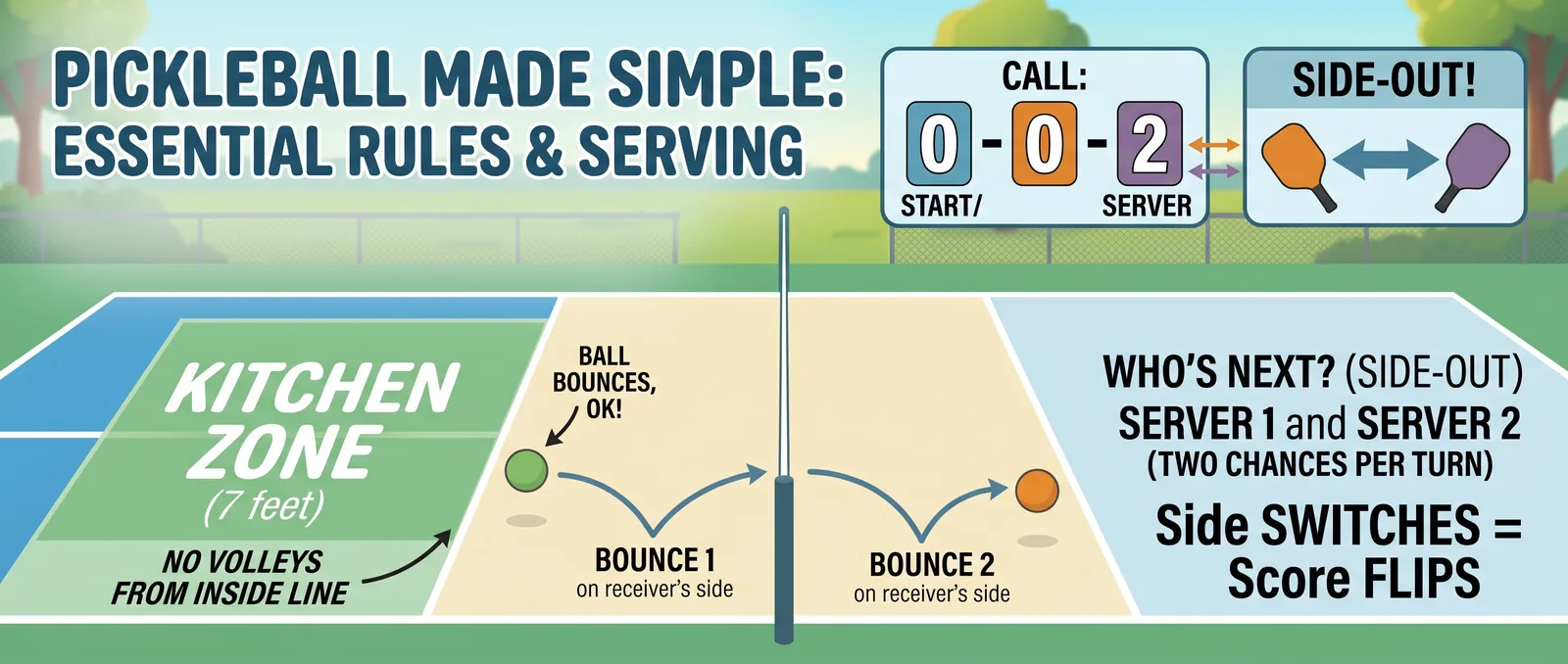
The “Two-Bounce” Rule: When the ball is served, the other team must let it bounce once before hitting it back. When they hit it back, your team must also let it bounce once. After those two bounces, you can hit it out of the air!
-
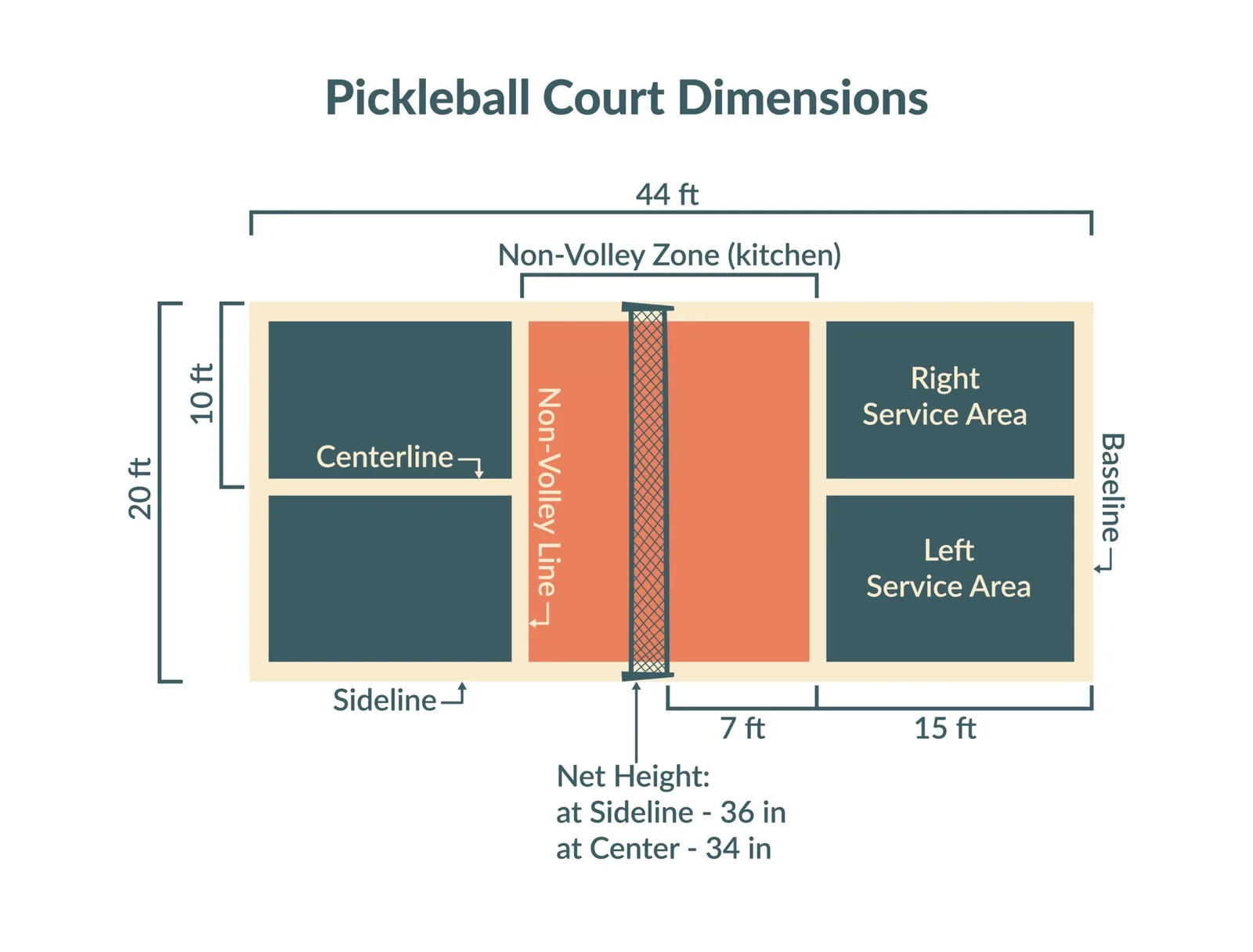
Stay Out of the “Kitchen”: That 7-foot box right next to the net is called the Kitchen. You cannot step inside it to smash a ball out of the air. You can only step in if the ball bounces inside it first.
🔢 How Doubles Scoring Works (The 3 Numbers)
Before you hit the serve in doubles, you must shout out three numbers:
[Our Score] | [Their Score] | [Server Number (1 or 2)]Key Rule: In traditional side-out scoring, you can only score points when your team is serving! First team to reach 11 points (and lead by 2) wins.
👥 The “Server #1 and #2” Concept (Your Team’s 2 Tries)
Think of doubles pickleball like having two lives or two tries to score points before you have to give the ball to the other team:
Team Turn Starts ──► [Server #1 serves until they lose a rally]
                           │
                           ▼
                     [Server #2 serves until they lose a rally]
                           │
                           ▼
"SIDE-OUT!" (Ball goes to the other team)-
Server #1’s Turn: The first player serves. As long as your team keeps winning rallies, your team gets points and you switch right/left sides with your partner. When you finally lose a rally, Server #1’s turn is done.
-
Server #2’s Turn: The ball doesn’t go to the opponents yet! Now your partner steps up as Server #2 and serves from wherever they are standing.
-
Side-Out (Passing the Ball): When Server #2 loses a rally, your team is out of tries. The other team takes the ball.
🔄 Why the Score Numbers “Flip” on a Side-Out
The server’s score is always called first. Whenever a Side-Out happens and the serve switches sides, the numbers in the callout flip positions:
-
If your team has 4 points and the other team has 2, Server #2 calls out:
4 - 2 - 2. -
If you lose that rally, the other team gets the ball. Because they are serving now, their score comes first: they call out
2 - 4 - 1!
🪄 The “0-0-2” Rule: How the First Turn Actually Works (USA Pickleball Section 4.B)
Under the official USA Pickleball Rulebook (Section 4.B), the opening serve follows strict positioning and scoring mechanics designed to keep the game balanced:
- Why the Call is “0-0-2”: To minimize the first serving team’s advantage, that team is only allowed one service turn before a side-out. Calling “2” designates that they are already on their second and final server turn.
- Even vs. Odd Court Positioning: Court positions are strictly tied to the team’s score. Because the match begins at 0 (an even number), the first server starts on the right/even service court and serves diagonally crosscourt to the receiver’s right service court.
- If They Win the Point: The server switches sides with their partner and hits the next serve from the left side calling
1 - 0 - 2. - If They Lose the Rally (Fault): Immediate side-out. The serve passes to the opposing team, whose first server begins on the right side calling
0 - 0 - 1. From that point on, both teams get their full two tries per rotation.
The “Two-Server Trick”: How Server Numbers (1 and 2) Actually Work
The third number in a doubles score call—the server number (1 or 2)—causes more confusion for beginners than almost any other rule.
The biggest myth? You are not permanently Server 1 or Server 2 for the whole match.
You do not wear a jersey with “1” or “2.” Your designation as Server 1 or Server 2 resets every single time your team wins back the serve (a side-out).
Court Position After a Side-Out: Doubles vs. Singles
Here is the biggest difference in positioning between doubles and singles: in doubles, the first serve after a side-out is ALWAYS hit from the right side of the court. In singles, where the serve starts is DEPENDENT ON THE SCORE.
In Doubles: Always the Right Side (Score Picks the Player)
Every side-out in doubles begins from the right service court. You do not choose where you stand; your team’s score strictly dictates which partner must be standing on the right side to take that first serve:
The player who started the game on the right side (the Starting Server) serves as the baseline tracker for the score:
- Even Score (0, 2, 4, 6…): The player who started the match on the right side must stand on the right side. That player takes the first serve as Server 1.
- Odd Score (1, 3, 5…): The player who started the match on the right side must stand on the left side. This puts their partner on the right side to take the first serve as Server 1 instead!
- Switching Sides: Teammates only switch left/right court positions when they score a point while serving. You never switch sides when you lose a rally, when the serve passes from Server 1 to Server 2, or when you receive a side-out.
Quick Sanity Check: If your team’s score is an even number and your original starting server is standing on the left side, someone is out of position!
👤 What About Singles? (The 2-Number Rule)
If you step onto the court for a 1-on-1 singles match, positioning becomes much simpler:
1. Only Two Numbers in the Score Call
In singles, there is no second teammate, so there is no third number. You simply call:
[Server Score] - [Receiver Score]- Example: If you have 4 points and your opponent has 3, you call
4 - 3.
2. Starts at 0 - 0 (No 0 - 0 - 2 Rule)
Because each player only ever gets one service attempt before a side-out, there is no need for the “second server” handicap at the start. Singles games simply start at 0 - 0. When the server loses a rally, it is an immediate side-out to the opponent.
3. Side-Out Serving Location is Dependent on the Score
Unlike doubles (which always starts on the right), a singles serve starts from whichever side matches your current score:
- Even Score (0, 2, 4, 6, 8, 10): Serve from the right-hand court diagonally to the opponent’s right-hand court.
- Odd Score (1, 3, 5, 7, 9): Serve from the left-hand court diagonally to the opponent’s left-hand court.
- The Receiver Mirrors: The receiving player always lines up diagonally across from where the server is required to stand.
The Big Takeaway: After a side-out in singles, if your score is 3, you don’t go to the right—you walk straight over to the left side to serve. If your score is 4, you serve from the right.
📋 Quick Reference: Doubles vs. Singles
| Rule | Doubles | Singles |
|---|---|---|
| Score Callout | 3 numbers: [Us] - [Them] - [Server #] |
2 numbers: [Server] - [Receiver] |
| Opening Score Call | 0 - 0 - 2 (Only 1 serve turn on first rotation) |
0 - 0 (Standard single serve) |
| Serves Per Side-Out | 2 serves (Server 1, then Server 2)* | 1 serve (Fault = immediate side-out) |
| Side-Out Serve Starting Side | Always on the right side (Score dictates which partner stands there) | Dependent on the score (Even = Right side, Odd = Left side) |
| Switching Sides | Only switch sides when your team scores a point | Only switch sides when the server scores a point |
* Except for the very first service turn of the game.
For complete details and rule interpretations, check out the official USA Pickleball Rules Summary and the USA Pickleball Scoring & Positioning Guide .