The Ultimate Beginner’s Guide to Pickleball: Rules, Strategy, and Quick Startup
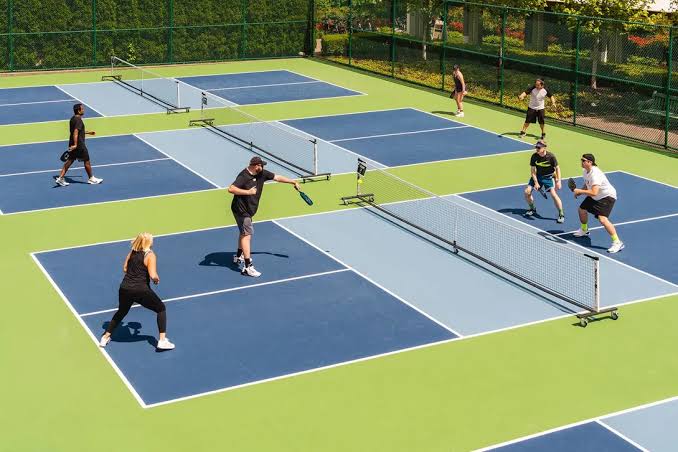
Pickleball is officially taking over the sports world, and it is easy to see why! It is fast, incredibly fun, and easy for anyone to pick up. Played on a compact 20x44 foot court with a 34-inch center net, it combines the best elements of tennis, badminton, and ping-pong.
Whether you are stepping onto the court for the very first time or just need to settle a rules debate with your friends, this definitive guide breaks down everything you need to know.
Another resource: How to play pickleball - 7 simple rules for beginners
🚀 The 4 Golden Rules for Quick Startup
If you want to skip the deep technical details and just start playing a game right now, memorize these four foundational rules:
-
Serve Underhand: You must strike the ball using an underhand motion, making contact below your waist.
-
Respect the Two-Bounce Rule: The serve must bounce once on the receiver’s side, and the return must bounce once on the server’s side. Only after these two bounces can you hit the ball out of the air.
-
Stay Out of the Kitchen: Do not step inside the 7-foot zone near the net to hit a ball out of the air (volley). You can only step inside if the ball bounces there first.
-
Call the 0-0-2 Magic Number: Before the very first serve of the game, the server must call out the starting score: 0-0-2.
1. Mastering the Serve
The serve starts the rally, but it comes with strict mechanics to keep the game fair:
-
Paddle & Arm Position: You must strike the ball below your navel. Your arm must move in an upward arc, and the paddle head must remain lower than your wrist.
-
The Drop Serve: Alternatively, you can drop the ball and hit it after it bounces. If you use a drop serve, all paddle and arm restrictions are waived.
-
Foot Placement: Keep at least one foot behind the baseline. Neither foot can touch the court or lines until after you strike the ball.
-
The Target: Your serve must travel diagonally cross-court, completely clearing the kitchen line to land inside the opposite service court.
-
One Shot Only: You only get one serve attempt. There are no second serves unless a “let” occurs (the ball clips the net but still lands in the proper box).
2. Understanding Your Service Side (Even vs. Odd)
Your team’s score directly determines which side of the court the server must stand on.
-
The Even/Right Rule: When the serving team’s score is even (0, 2, 4, 6, 8, 10), the serve must be hit from the right side of the court (also called the even court) into the receiver’s right side. Because the game starts at 0-0-2, the very first serve of the game is always delivered from the right.
-
The Odd/Left Rule: When the serving team’s score is odd (1, 3, 5, 7, 9), the serve must be hit from the left side of the court (also called the odd court) into the receiver’s left side.
-
The Starting Right-Side Player: In doubles, the player who starts the game on the right side remains the benchmark. Whenever that team’s score is even, that specific player must be on the right side of the court. When the score is odd, that player will be on the left side.
3. The Two-Bounce Rule Explained
This rule prevents teams from immediately rushing the net and smashing the ball down.
-
Bounce 1: The receiving team must let the serve bounce before hitting it back.
-
Bounce 2: The serving team must let the return bounce before hitting it back.
-
Open Play: Once those two initial bounces happen, the restrictions vanish. You can either volley the ball out of the air or play it off a groundstroke bounce.
4. Surviving “The Kitchen” (Non-Volley Zone)
The 7-foot marked area closest to the net is affectionately called the kitchen, and it has unique rules:
-
No Air Strikes: You cannot stand inside the kitchen—or touch its boundary lines—while hitting a volley.
-
Watch Your Momentum: If you hit a volley from outside the kitchen, your forward momentum cannot carry you into the kitchen afterward, even if the rally is already over.
-
Bounces Allowed: You can enter and stand in the kitchen freely after a ball bounces inside it.
5. Scoring, Rotation, and the 0-0-2 Exception
Pickleball scoring looks intimidating at first because you call out three numbers: Server Score - Opponent Score - Server Number (1 or 2).
-
Side-Out Scoring: You can only score points when your team is serving. Games are played to 11 points, and you must win by 2.
-
The First Turn Rule: The game starts at 0-0-2. To prevent the first serving team from having too big of an advantage, only one partner gets to serve on the very first turn.
-
The Double Serve Sequence: Once that first server faults, a “side-out” occurs. For the rest of the game, both partners on a team get a turn to serve before passing the ball back to the opponents.
-
Switching Sides: When your team wins a point on your serve, you and your partner switch sides of the court. The same player continues serving, but they will now move to the alternate side to match the new score (even or odd).
-
Singles Play: In singles, there is no third number called out. The server simply tracks their own score to decide their side: serving from the right when even, and from the left when odd.
6. Line Calls and Faults
-
Lines Are Good: If a ball lands on the baseline or sideline, it is in.
-
Except the Kitchen Line: If a serve lands directly on the receiver’s kitchen line, it is considered short and counts as a fault.
-
Call Your Own Side: Players are responsible for calling lines honestly on their own side of the net.
-
What is a Fault?: A fault is any rule violation that ends a rally. If the serving team faults, they lose the serve. If the receiving team faults, the serving team wins a point.